Archive for the ‘Exploring the Mind Body Connection’ Category


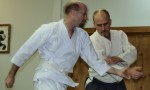
In the face of a threat, automatic “orchestrations” direct both thought and action.  In an auto pilot reaction to a physical threat (e.g., being grabbed) the body may tense up and the mind may freeze, undermining our ability to move efficiently and think clearly.  Same thing can happen in a non-physical confrontation — the overall “fight/flight/freeze” orchestration interferes with clear thinking and effective communication.

On the flip side, because cognitive and physical systems are interwoven threads within the larger fabric of a whole living person, it’s possible to override the automatic orchestration through mindful attention.  The influence of attention acts from within the orchestration (it’s not an external “player.”)  It’s like an eco-system — a significant change to one part of the system shifts the dynamics of the whole thing.

The internal side of martial art’s training (called “Ki” training in Ki-Aikido) is about learning how to use mindfulness to switch out of an auto pilot reaction and into a high performance state that allows us to take informed action.

The connection between body and mind reveals itself in ordinary experience, sports performance, time-honored practices such as the martial arts and yoga, and now in the scientific study of the brain. This category explores insights from the intersection of life experience, traditional practices, and neuroscience.

Relax completely addresses the subtle background tension held in our body that’s a part of our “steady-state.”  We don’t pay attention to it – it’s the postural status quo when sitting at the computer, or driving the car, or swinging the golf club.

We don’t notice that we aren’t relaxed completely.

It may result from the lean of my posture as my attention locks on the computer screen — the automatic contraction of muscles in shoulders and back to hold my body in the lean.  Or the set of my jaw and the rise of my shoulders as I sit stuck in rush hour traffic.  We only notice the tension after it adds up to cause discomfort or pain.

During an aikido movement, it’s the sublte tension that happens “of its own accord” as I lean while turning, or when I push or pull against my opponent.  We don’t notice the tension, we only notice the outcome — that the movement is awkward or ineffective.

Relax completely begins with awareness of the “status quo” postural tension we carry during everyday actions and activites.

The interweaving of cognitive systems (attention, alertness, memory, decision-making) with physical systems (circulation, breathing, digestion, balance, movement) allows us to take informed action.